Treasury Bill yields
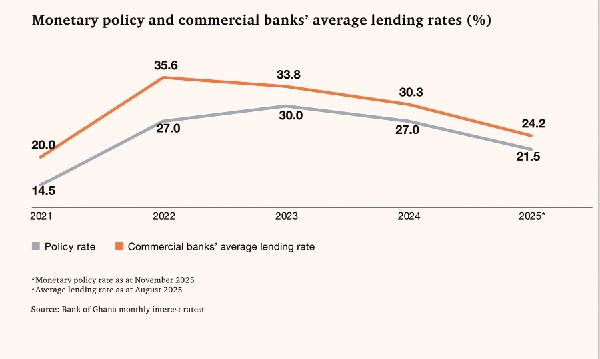
The Governor noted that the declining yields on Treasury Bills will likely prompt banks to boost lending, potentially leading to more significant reductions in lending rates in the future.
“Average lending rates have already fallen by more than 7 percentage points since the beginning of 2025”, he said.
Data from the Bank of Ghana’s November 2025 Summary of Economic and Financial Data show that the average cost of borrowing dropped to 22.22 per cent in October 2025, down from 30.07 per cent in January 2025.
Although the downward trend was not without its bumps, with rates edging up to 30.12 per cent in February 2025 before stabilising and eventually resuming their decline.
The average lending rate dipped to 29.18 per cent in March, 27.40 per cent in April, and 26.90 per cent in May, with a slight uptick to 27.00 per cent in June, before settling into a steady downward trajectory.
Ghana Reference Rate
A similar downward trend is evident in the Ghana Reference Rate (GRR), which dropped to 17.86 per cent in October 2025 from 29.72 per cent in January 2025, reflecting enhanced liquidity conditions and declining money market rates.
Despite the overall decline, lending rates remain highly divergent across banks and sectors. While some institutions now offer loans at rates aligned with the Ghana Reference Rate, others still charge borrowers up to 39 per cent, reflecting varying assessments of borrower risk.
The Governor stressed that lower lending rates are critical for boosting private sector activity, driving job creation, and sustaining economic growth.”
“It is one of the things I particularly want to be assessed by at the end of my tenure—seeing lending rates as low as they can be,” Dr Asiama stated.
Macroeconomic indicators
Ghana’s economy was on the rise, with a growth rate of 6.3 per cent in the first half of 2025, surpassing the revised target of 4.0 per cent.
Finance Minister, Dr Cassiel Ato Forson, was thrilled with the progress, attributing it to the government’s prudent economic policies.
Inflation, which had been a major concern, had finally started to trend downwards, reaching 8.0 per cent in October 2025, its tenth consecutive monthly decline.
Food inflation had also decreased to 9.5 per cent from 11.0 per cent in September 2025, while non-food inflation stood at 6.9 per cent, down from 8.2 per cent in the previous month.
One of the most significant achievements was the reduction of Ghana’s public debt-to-GDP ratio to 45 per cent as of October 2025, down from 61.8 per cent at the end of 2024.
This historic correction was a testament to the government’s commitment to fiscal discipline.
Gross reserves
The country’s gross reserves have also strengthened, supporting the stability of the cedi. With 4.8 months of import cover, up from 4 months, the country’s economy is better equipped to withstand external shocks.
The cedi’s impressive rally of almost 35 per cent this year is largely due to strong cocoa and gold prices.
As of October 2025, the interbank exchange rate stood at approximately 10.9 GHC/USD, a significant improvement from previous years.
Source: Graphic Online