


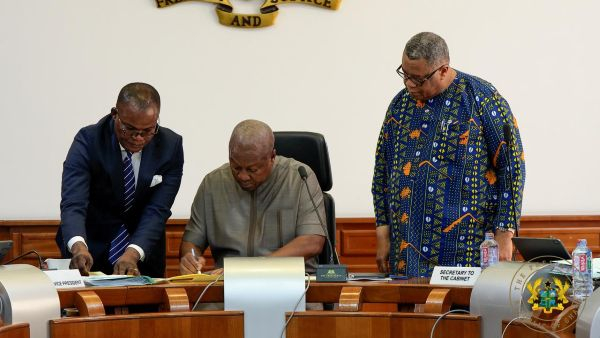
Finally, the 24-Hour Economy Authority bill has been signed into law by President John Dramani Mahama, paving the way for full implementation of government’s flagship economic policy.
It was approved on February 6 after several days of debate in parliament, following its presentation to the House at end-2025. The law establishes a 24-Hour Economy Authority to serve as the central coordinating body for the policy’s nationwide rollout.
The Authority will collaborate with key government institutions, private sector actors and other stakeholders to ensure effective implementation of round-the-clock economic activities across the country.
The President observed that signing the bill marks a shift “from strategy to implementation” with a strong emphasis on job creation for Ghanaians.
f8betv.vip F8BET – F8BET80.ONE Link Trang Chủ Chính Thức F8BET 2026
In a related development, the Association of Ghana Industries (AGI) has commended government and parliament for passing the 24-Hour Economy Authority bill, 2025 – expressing its readiness to partner government in ensuring the initiative’s effective implementation.
According to AGI, passing the bill is timely as export diversification remains essential to long-term sustainability of Ghana’s economic recovery. The association also believes its effective implementation will create jobs, increase productivity, boost exports and reduce reliance on imported goods.
“The 24-Hour Economy’s success will ultimately depend on strong coordination, policy consistency and sustained engagement with industry,” the association stressed.
Parliament officially passed the 24-Hour Economy Authority bill, 2025, after extensive deliberations and debate between the Majority and Minority caucuses on the floor of the House.
Under its legislation, the Authority will be tasked with aligning public and private sector initiatives, mobilising investment and ensuring that the necessary regulatory and infrastructural support systems are in place to sustain round-the-clock economic activity.
The 24-hour economy policy was a key campaign promise of the NDC during the 2024 general elections and has been positioned by government as a major driver of job creation, productivity and economic growth.
However, the bill was not without controversy as members of the Minority caucus raised concerns during the debate – warning that the policy could pose security challenges and create inconvenience for Ghanaians if not carefully implemented.
Despite these objections, the Majority caucus argued that benefits of the policy outweigh concerns, noting that adequate security and regulatory measures will be put in place to support its successful rollout.
Source: thebftonline.com
