


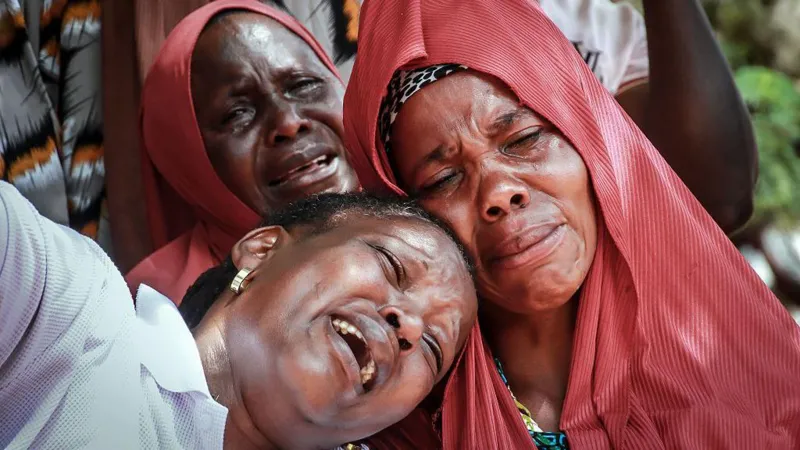
October’s shocking events in Tanzania offer a snapshot of some of the tensions which have shaped a difficult year for African politics.
Demonstrators were shot dead by police while protesting against what they saw as a rigged election – condemned by regional and continental bodies – shattering the country’s reputation for peace and stability.
With opposition candidates either imprisoned or barred from running, President Samia Suluhu Hassan was elected with 98% of the votes.
Any moves towards Tanzania becoming a more open democracy had been seemingly reversed.
Arguably what happened there highlighted a broader breakdown in many African nations between the people and those who govern them.
Several countries saw protests and election disputes in 2025, while military leaders cemented their power in others, with analysts believing next year could bring more upheaval.
“If we look at the overall picture across the continent, the trend is worrying,” said Mo Ibrahim, whose foundation analyses data to assess the state of African governance.
Its most recent report suggests that in its measure of governance, which includes things like security, participation in decision-making and the state of health and education, progress has stalled when compared to the decade up to 2022.
“The increase in coups [in recent years], the return of military governments and the closing of democratic space all point to the same problem: a failure of governance.”
The spike in the cost of living has been the spark that lit the fire of dissatisfaction in many places. This was not unique to the continent but, as Mr Ibrahim told the BBC, “the risk for Africa is that these negative patterns spread unchecked, much of the hard-won progress achieved over recent decades could be reversed”.
 AFP via Getty Images